Bakery Pre-Orders and Custom Cakes: the Page That Stops the Phone Tag
Most custom order enquiries die in three rounds of messages. The page structure, fields and lead-time rules that let a bakery quote once and move on.
- Operations
- 12 min read
- 2,667 words
- 5 questions answered
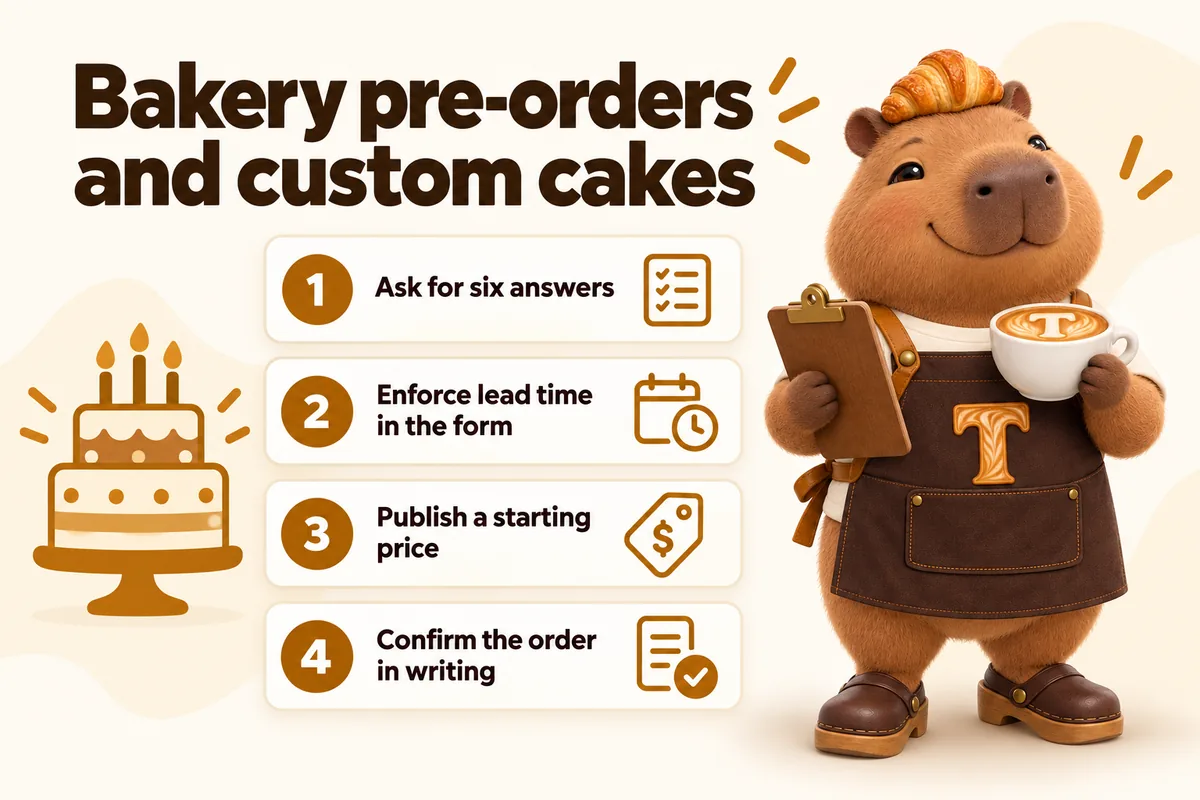
Most custom order enquiries at a bakery die somewhere in the third message. Somebody asks about a cake, the reply asks what date, the answer comes back two days later, the reply asks what size and how many people, and by the fifth exchange the customer has ordered from somewhere with a form that asked everything at once. The fix is not a better reply. It is a page that collects the answer to every question you were going to ask before the enquiry ever reaches you. This is what goes on that page, in what order, and what it should refuse to accept.
Why the enquiry form is the actual product
For a bakery doing custom work, the pre-order page is not a marketing page with a form at the bottom. It is the highest-value operational page on the site, because it is where an unstructured conversation becomes a structured job.
Think about what happens on either side of it. Before it, somebody has an occasion, a rough idea and a budget they have not said out loud. After it, you need a date, a specification and a price. The page is the thing that converts one into the other, and every question it fails to ask becomes a message you have to send.
That framing changes the design. The page is not trying to be beautiful and then capture a lead. It is trying to be complete.
The six answers a quote needs
Here is the minimum set, in the order to ask them, with the reasoning for each.
The date
Ask first, because it is the only answer that can make everything else irrelevant. If the date is tomorrow and you need five days, nothing else on the form matters, and the customer should find that out at the top of the page rather than after filling in nine fields.
Use a real date input rather than a free text box. The native date input type gives the customer their own device’s date picker, which they already know how to use, and gives you a date in an unambiguous format rather than “the 3rd” with no month.
Crucially, constrain it. Set the earliest selectable date to today plus your genuine lead time. A form that will happily accept a date you cannot serve is a form that generates an apologetic message and a disappointed customer, both avoidable.
The size, expressed as people
Ask how many people it needs to serve, not what size in inches. Customers know how many people are coming. They do not know what an eight inch round serves, and asking them to guess produces wrong answers that you then have to correct.
If you work in tiers or specific sizes, translate on your side, and put the translation on the page as reference so somebody who does know can choose directly.
The flavour or the type
A short list of what you actually make, plus a free text box for anything else. The list does two jobs: it collects a usable answer, and it quietly communicates the range of what is possible, which is information customers frequently do not have.
Do not present a list of thirty options. Six to ten, plus “something else, tell us”.
Collection or delivery, and where
Two very different operations, and the page should not assume. If you deliver, say where, say what it costs, and say what the cut-off is. If you do not, say so plainly rather than leaving it as a question people ask.
For collection, the useful extra field is a rough time, because a collection at eight in the morning and one at four in the afternoon are different jobs on your side.
The budget band
This is the field most bakeries leave off, and the one that saves the most time.
Not a precise number. A set of bands, phrased in your own range, with the lowest band starting at your actual starting price. The purpose is not to price the job before you have seen it. It is to prevent the enquiry that arrives wanting a three-tier wedding cake for the price of a sheet cake, which currently costs you a careful, gentle, time-consuming reply.
Offering bands rather than a free number also makes the question answerable. A customer who has no idea what a cake costs can pick a band. They cannot type a number.
What it is for
One short free-text field: the occasion, any wording, any colour, anything they have seen and liked. This is where all the detail you cannot anticipate arrives, and it is where the useful information hides.
Keep it optional and keep it last, because a large empty text box at the start of a form is where people stop.
Fields to leave off
Every field costs completions. Four common ones are not earning their place.
Phone number, as a required field. Make it optional unless you genuinely only work by phone. Plenty of customers strongly prefer not to be called, and requiring it loses them at the last step.
Address, before it is needed. Only ask if they have chosen delivery. Asking everyone for a full address to collect a cake in person is friction with no return.
How they heard about you. Useful to you, irrelevant to them, and it sits at the end of the form where it can only cost completions.
Anything you will not read. If nobody looks at the answer, remove the field. Most forms have at least one of these left over from the version before last.
Making the form itself work
The mechanics matter more than the design here, and the requirements are well established.
Real labels, always visible
The accessibility requirement for labels or instructions is that when input is required, labels or instructions are provided. In practice that means every field has a visible label attached to it, not a placeholder that vanishes the moment somebody types.
Placeholder-only forms are a persistent design fashion and a persistent usability failure. The customer filling in field seven cannot remember what field three was asking, and on a long custom order form that is a real problem.
Errors that say what to do
The error suggestion requirement is that when an error is detected and a correction is known, the correction is suggested. “Invalid date” is not that. “We need at least five days to make this. The earliest date we can offer is the 14th” is.
This is not just compliance. On a form whose whole purpose is to prevent a conversation, an error message that explains the rule is the conversation, resolved in advance.
Let the browser help
Set the autocomplete attribute properly on name, email, phone and address fields, so the customer’s own browser fills them in. On a phone, this is the difference between a form taking ninety seconds and taking four minutes, and four-minute forms on phones do not get finished.
Use the right input types for the same reason: a numeric keypad for numbers, an email keyboard for emails, a date picker for dates.
One screen at a time on a phone
A fourteen-field form on a phone is a scroll of doom. Grouping it into two or three short steps, with progress visible, measurably helps, provided the steps are genuinely short and the customer can go back.
The one thing not to do is hide the total length. A form that reveals itself to be longer than expected at every step is worse than an honest long one.
What happens after submit
The page is half the job. The other half is what the customer sees and receives in the next sixty seconds.
A confirmation that repeats the order back
Not “thanks, we will be in touch”. A confirmation, on screen and by email, that repeats what they actually asked for: the date, the size, the flavour, collection or delivery, and what they wrote in the notes.
This is worth doing for one unglamorous reason. Most disagreements about custom orders are memory problems, not bad faith, and a written record created at the moment of the request resolves nearly all of them before they start.
A realistic promise about the reply
Say when you will reply, in a form you can actually keep. “We reply within one working day” is a promise. “We will get back to you as soon as possible” is not, and it produces the follow-up message you were trying to avoid.
If you only quote custom work on certain days, say that too. A customer who knows they will hear on Thursday does not chase on Tuesday.
The quote itself
Quote once, completely, with the price, what it includes, what would change the price, the deposit if you take one, and the date by which you need confirmation. A quote that requires a follow-up question has failed at the same job as a form that required a follow-up question.
Deposits and cancellations, stated plainly
If you take a deposit, say how much, when, and what happens to it if the order is cancelled. If you have a cut-off after which an order cannot be changed, say the cut-off.
None of this needs legal language. It needs to be written down before it matters, on the page where somebody agrees to it, so that the awkward conversation is a reference to something they already read.
The page around the form
The form needs a page around it, and the page has four jobs.
Show what you have made. Photographs of real orders, plainly presented, with a line about what each one was. This is the only reliable way somebody decides you can make the thing they are imagining.
State the starting price and what moves it. “From this much, with price depending on size, tiers and decoration” is enough. It filters the enquiries you cannot serve without publishing a full price list.
State the lead time in the same words the form enforces. So there is no gap between what the page says and what the date picker allows.
Answer the questions you get asked most. Whether you can match a picture, whether you do a particular dietary version, how far you deliver, whether you do small orders as well as large. Every one of these that is answered on the page is a message that never gets sent.
Pre-orders that are not cakes
Custom cakes get the attention, but for most bakeries they are not the largest pre-order category. Three others are usually bigger, and each wants a different page.
Standing bread orders
A customer who wants two sourdough loaves every Friday is the most valuable kind of pre-order, because it is predictable production rather than a one-off scramble. The page for it is short and unglamorous: which items are available as a standing order, which days, the cut-off for changing a week, how to pause for a holiday, and how payment works.
The field that matters most is the pause. A standing order somebody cannot pause for a fortnight in August becomes a standing order they cancel in July. Make pausing obvious and easy and a much higher proportion of these survive the first summer.
Catering and office orders
These are larger, less frequent and more anxious. The customer is ordering on behalf of other people and is worried about quantity, dietary requirements and timing, in that order.
The page needs three things the cake page does not: quantities expressed in people rather than items, a clear delivery window rather than a time, and a statement of what happens if the headcount changes. Add a minimum order value if you have one, stated at the top, because a catering enquiry below your minimum costs the same amount of time to decline as one above it costs to win.
Seasonal and holiday pre-orders
The highest volume pre-order most bakeries take is the one that happens three or four times a year: the holiday bread, the celebration item, the seasonal box. These have a fixed production run, a hard cut-off and a collection window.
Build this as a page you can switch on and off rather than as a form you rebuild every time. The structure stays constant across seasons: what is available, how many, the cut-off date, the collection window, and how to pay. Only the item and the dates change. A shop that has this page as a reusable structure can open holiday pre-orders in fifteen minutes instead of a week.
The single most important element is a visible cut-off and a visible cap. “Orders close on the 18th or when we reach capacity, whichever comes first” is honest, creates a real reason to act, and protects your kitchen from a headcount it cannot make.
What to do when you are full
Every bakery reaches the point where it cannot take another order for a given week, and almost no bakery’s website handles this. The form keeps accepting enquiries, and somebody has to write an apologetic reply to each one.
There are three workable answers, in increasing order of effort.
The simplest is a notice on the page with a date: “We are fully booked for the 20th to the 27th.” Manual, needs updating, but it is a single line and it stops most of the wasted enquiries immediately.
Better is to remove the full dates from the date picker, so an unavailable date cannot be chosen at all. The customer discovers the constraint while choosing rather than after submitting, which is the entire principle this page runs on.
Best, for shops with enough volume to justify it, is a waiting list option on the full dates. Somebody who cannot have the 20th may well take the 21st, and a form that offers that alternative at the moment of disappointment converts a meaningful share of them.
Whichever you choose, say something. A form that silently accepts orders you cannot make is generating work for you and disappointment for somebody else.
A worked shape for the page
In order, top to bottom: a short line saying what you make to order and the minimum lead time. Six to ten photographs of real work. The starting price and what moves it. The lead time and the cut-offs, stated. The form, date first. The frequently asked questions. The collection address and hours, because that is the next thing somebody wants after ordering.
That is a page that can be read in ninety seconds, filled in in three minutes, and quoted from in one reply. Compared against the current version, which for a great many bakeries is a phone number and a sentence saying “contact us for custom orders”, it is the single highest-return page on the site.
Sources
Frequently asked questions
What is the biggest reason custom cake enquiries fall through?
Missing information. An enquiry that arrives without a date, a size or a budget cannot be quoted, so it becomes a message asking for those things, and every round of messages loses people. A form that asks for them up front turns three rounds into one reply.
Should a bakery publish prices for custom orders?
Publish a starting price and what moves it. You do not need a full price list, but a page with no numbers at all attracts enquiries from people whose budget is nowhere near yours, and each of those costs you a reply.
How much lead time should a pre-order page ask for?
Whatever your kitchen genuinely needs, stated as a rule the form enforces rather than a sentence people skim. If you need five days, the date picker should not offer tomorrow, because a form that accepts an impossible date creates a conversation you then have to have.
Do I need online payment for pre-orders?
Not to start. A deposit reduces no-shows, but taking payment adds obligations. A clear written confirmation of what was ordered, for when and at what price, solves most of the same problem at a fraction of the complexity.
What should the page say about allergens and dietary requirements?
Whatever your own kitchen policy says, in your own words, and it should ask the customer to tell you their requirements rather than implying the form can assess them. The website collects the request; the conversation and your own procedures decide what is possible.
Want a site like the one described here? Book a demo with GetCafeWebsite.